
"The Road to Captivity", Part 11; A Study in Jeremiah, Chapters 46-49
ZADOK PUBLICATIONS - Dr. C. R. OLIVER
May 1, 2010
|
You may watch this Newsletter in a video HERE.
ZADOK PUBLICATIONS MONTHLY NEWSLETTER
Introduction:May 1, 2010 "The Road to Captivity", Part 11 A Study in Jeremiah, Chapters 46-49 Jeremiah's Address to the Nations Jeremiah's Flash Back: Flash backs occur both in Jeremiah and Ezekiel's works. Both prophets occasionally travel backward in time and bring up events or prophecies which were given in previous years. These prophecies influence or cause the reader to grasp the determinations of God, while viewing a former time frame, in order to show their relevancy to current events. God had already given Judah their final warning about Egypt and what would happen (and did happen) to those who determined to rely upon the Egyptian-pagan society for support. He had already given Jeremiah words about their affected history. Jeremiah used a flash back prophecy to bring the people "up to speed" in their comprehension of God's hand in judgment and the course of the future. Last month's newsletter ended with a small flash back. It involved Jeremiah's scribe and faithful companion, Baruch. He gave an insight as to why Baruch did not seek fame for himself and had remained in the shadow of the man of God instead. Now, Jeremiah returned to a former prophetic word about Egypt. It was one God had given him-words which related to His actions regarding Judah's decision to head for Egypt for protection. Jeremiah turned backward in time and reminded his readers that Egypt had been cursed (more than once) for their treatment of God's people. Egypt was never to be a national destination. Background: During the reign of Jehoiakim, and significantly into the king's fourth year, God stepped into politics and brought down a kingdom. Jeremiah marked the name of Pharaoh Necho. Necho killed Judah's good King, Josiah (Jeremiah was a close friend and lamented his death), in 609BC. Jehoiakim succeeded to the throne but was a vassal to the Pharaoh from 609-605, when God stepped in with judgment. The fourth year of Jehoiakim's reign became an important date. It marked the beginning of a series of prophetic words which would affect the history of the world. God began to speak words to the power-nations of Jeremiah's day, and those judgments unleashed by the prophet still hold authority even in today's politics. Necho's power grab in Israel did not go unnoticed by the Lord. Just when Necho started "strutting," Babylon stepped in and defeated the mighty Egyptian army at the famous battle of Carchemish, 605 BC. Jeremiah pointed to God being the cause of that defeat. (How many times has the Lord overtly intervened in history? -only eternity will tell.) As each prophecy unfolds, there is one central theme: God is uncovering, ripping away the façades under which they perform and showing where and how each nation went wrong and what the consequences would be for them.  Chapter 46 Prophecy Against Egypt 605BC The joy of reviewing this prophecy falls along two lines: first, the message given to Israel (not just Judah), "God will provide;" second, a message to the two nations of Egypt and Babylon: "God is in charge." The Lord knew the haughtiness of the Egyptians and the arrogance of their King Necho. The head of a government is always regarded as representing the people he or she rules (ie: Obama, Chavez, Castro, Putin). Necho represented a people of arrogance and pride. They were pagan people with gods and sorcery equaling that of the modern world. This scripture reflects the attitude of the Egyptians toward the nations of the world. They viewed themselves in terms of military prowess. "I will go up and cover the earth," was not an advertisement for the Sherwin-Williams paint company.Egypt rises up like a flood, Notice must be made of the involvement of all Africa in these Scriptures. Often readers relate to Egypt as the land mass of today's modern map, but the kingdom had far reaching autonomy over many areas: Ethiopia, Libya, and Lydia are only three which are mentioned here. (The curse upon Egypt extended and included territories beyond Cairo. I firmly believe that Africa must yet deal with the Egyptian curse. They must repent of their association with the Pharaoh's of old or else continue to bear the consequences of that affiliation.)* Egypt reneged on their promises to Moses, every one of them. The affiliate cultures branching from that dynasty have learned Egyptian ways. *(See: article at end regarding Uganda.) Since the Egyptians refused to sacrifice to the Living God, God created His own sacrifice. He made Egypt the sacrifice. The reader should realize that Jeremiah was receiving this report before it happened in history. O, that the so-called "modern prophets" were so accurate.For this is the day of the Lord GOD of hosts, A day of vengeance, That He may avenge Himself on His adversaries. The sword shall devour; It shall be satiated and made drunk with their blood; For the Lord GOD of hosts has a sacrifice In the north country by the River Euphrates. Jeremiah called out the names of the Egyptian border cities: Migdol, Noph (Memphis, the capitol of the northern portion) and Tahpanhes (where God's last appeal to Judah took place). Since Noph was specifically addressed, God was saying, "Noph (Memphis) represented the whole northern area and along with all its population." (It would be like saying Washington, D.C. represented America or the Kremlin representing Russia.) Thus, the following passage was addressed to the common population (known as the "daughter of Egypt.") Everyone suffered because of the arrogance of the few.The word that the LORD spoke to Jeremiah the prophet, how Nebuchadnezzar king of Babylon would come and strike the land of Egypt. God took responsibility for the defeat of Egypt. The reader should remember that Jeremiah was with the band of Judah at Tahpanhes as they entered Egypt. He reminded them that Pharaoh's judgment would be entered into by "those who trust in him." (It is time to review "associative judgment," especially in these "Change" times.)The daughter of Egypt shall be ashamed; Is it any wonder the population eventually cried out,The LORD of hosts, the God of Israel, says: "Behold, I will bring punishment on Amon of No, and Pharaoh and Egypt, with their gods and their kings - Pharaoh and those who trust in him. And I will deliver them into the hand of those who seek their lives, into the hand of Nebuchadnezzar king of Babylon and the hand of his servants. Afterward it shall be inhabited as in the days of old," says the LORD. They cried there, 'Pharaoh, king of Egypt, is but a noise. The judgment upon Egypt would cause consternation to the nations of the earth, but Jehovah comforted the sons of Jacob (true Israel). He gave a promise that is yet to be fulfilled.(Would anyone care to draw some modern parallels at this juncture?) Many facets surround these verses. "Jacob shall return, have rest and be at ease…No one shall make him afraid" is not the state of modern Israel nor has it been since its inception in 1948.'But do not fear, O My servant Jacob, The Lord was not addressing just Judah and the Southern kingdom with these verses. This was universal-it is prophecy about a coming day beyond the present hour. Jacob is to be saved from afar with his offspring-which includes me and many of you. However, there is a message to the nations of the earth: "For I will make a complete end of all the nations to which I have driven you." Does this mean what it says? That being the case, does it refer only to those nations around the holy land? Does it mean a massive world wide judgment? (I think you know these answers as I do. YES!) Summary: Egypt's great sin: They became God's adversary. 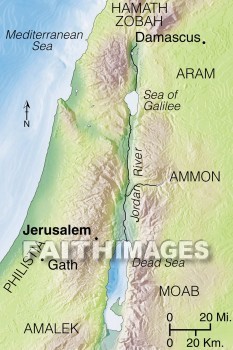 This Bible Map shows the areas covered in the next prophecies: Chapter 47: Prophecy against Philistia or the Gaza area: (This is yet another flash back, but keep in mind the order of these nations and areas which are addressed in these chapters.) The words of this prophecy are valid this very hour! The Gaza area even today is under judgment, and those who occupy it are the recipients of more than they bargained. No help shall come to them. Seeking to raise up a separate Islamic state will not prosper and it is in conflict with: Even the slightest study of the region brings to mind Samson and the repeated assault of this region against the nation Israel. The question is how long will this judgment remain on that land? The answer is simple:The coast shall be for the remnant of the house of Judah Summary: The Gaza Strip, as it is referred to today, will ALWAYS have turmoil. War and loss of life are due to one thing: its population's refusal to honor the true and living God."O you sword of the LORD, Chapter 48 Prophecy Against Moab (Author's Note: Each of the places God addresses surrounds the land of Israel [Moab, Amman, Edom & etc]. This series of prophetic words culminate with a long word to Babylon, and a great portion of these remaining chapters are given to words against that nation.) Words of destruction flow over the Moabites. Why? God offers a simple explanation. (Is there anyone out there who will connect the dots?)For because you have trusted in your works and your treasures, Next is a short line that must be considered in light of the modern church and the work of ministry today. There is a great curse upon those who devise and carry out or support such deceit. Hearken to the words of the Spirit concerning the churches! An interesting simile is now offered by the Lord:Cursed is he who does the work of the LORD deceitfully (In the Sons of Zadok, I compare the carrying away of the Ark and the death of the sons of Eli to the modern church. Even though Jacob's name was changed to Israel at the altar at Bethel, the defeat of Israel at that place, during Eli's time, constituted the end of Bethel as a resting place and as a place of honor for their forefathers.)Moab shall be ashamed of Chemosh, It is the pride-filled Centro-centric nation which asserts itself against God, which garners God's wrath. That nation shall perish. (Is not the purpose of this study to focus upon the "Road to captivity???" What destroyed Moab will destroy any nation. What destroyed Egypt will destroy others.) Self aggrandizement beckons for judgment to come.Make him drunk, When God brings judgment, who can stand against it? Who can weather His storm? What path of escape can be found?We have heard the pride of Moab Yet, a promise is given to Moab:The mighty men's hearts in Moab on that day shall be (Because of my ongoing study of the fire of God, I am intrigued with this passage:'Yet I will bring back the captives of Moab But a fire shall come out of Heshbon, It would do well to establish the fact that this territory formed itself into what is now known as the Arabians. So, there is great evidence (for me, at least) that the fires of tumult have blazed in them since this time and will not be extinguished by any treaty or foreign intervention.(Jeremiah 48:45-47 'The words, "for a fire has gone out from Heshbon," are a verbatim repetition of what we find in Num 21:28.' [from Keil & Delitzsch Commentary on the Old Testament: New Updated Edition, Electronic Database. Copyright (c) 1996 by Hendrickson Publishers, Inc.]) (Moab was the illicit son of Lot and his eldest daughter. Moab was the country that opposed Israel's taking the land of Canaan. They refused Israel the use of their roadways and exacted great stress on them. When Reuben and Gad took land, during the invasion of Canaan, they took part of the territory claimed by Moab, thus invoking a resentment that played out in time. [Ruth was a Moabite, which must be reckoned with in the lineage of David. Moses was buried in the land of Moab as well. Does this lessen the judgment? Perhaps it does, because of their "last days" treatment.] ) Much was spoken against Moab, however, that is permanent. They were completely destroyed, even to this day, only rubble can be found of their ancient kingdom. They deliberately led the people of God into sin and worship of their gods. Solomon placed a high site for their pagan worship in Israel. Their priests of Chemosh offered human blood sacrifices. Their hatred for Israel, and their God, extended throughout their history. Since Chemosh was their sun god, the Lord told them the fire they worshipped would fall on them. This is cause enough for every Christian to test the fire and determine its source.'Yet I will bring back the captives of Moab What stronger words could be spoken over a nation of people than these?And when the king of Moab saw that the battle was too fierce for him, he took with him seven hundred men who drew swords, to break through to the king of Edom, but they could not. Then he took his eldest son who would have reigned in his place, and offered him as a burnt offering upon the wall; and there was great indignation against Israel. So they departed from him and returned to their own land. Summary: the following four references sum what is the prime reason God destroyed them-it was their own doing, their own welcoming committee to the chariots of death.For because you have trusted in your works and your treasures, Let it be known that "the year of their punishment" does more than hint that the sealed orders of God will be carried out against any nation that follows the lead of Moab!(1) Make him drunk, Chapter 49 Word against the Affiliate Cultures: Ammon: Those cultures who embrace the same principles as Moab and Egypt all but await their turn at the wheel of judgment. Affiliate cultures have associative judgment. Now it is Ammon's time. The people of Ammon were deeply associated with Moab in causing grief to Israel. They were the offspring of Lot's youngest daughter initially called Ben-Ammi and later referred to as Ammon. They occupied contiguous territory, known mostly as the "plains of Moab." The Amorites (separate people) took their land later on. Look what the Lord declared to be their sin: Yet, the Lord declared He would have mercy upon them:Why do you boast in the valleys, Edom'…But afterward I will bring back The descendants of Esau never had a good relation with Israel and that is who the Edomites were. Bearing ties to Cane and Esau exacted a great curse upon them. Now, affiliated with Moab and Ammon, their time has come. One of the principle cities was Bozrah, in which an exacting toll was garnered. Edom, the great city on the top of the mountains east of Israel (currently Jordan); also boasted Petra, the tourist attraction that daily attests the judgment of God. Jackals do habituate in these ruins (see: Obadiah). Their proud defiance of the will of God cost them everything. (They assisted the enemies of Israel by providing lodging and a route to make war against them. They stood against Israel when they refused them passage and supplies when they sought to cross over to pursue their enemies. In one earthquake, God opened a passage through the mountains that made their city obsolete-there was no need to travel there for the mountain passage God opened below them was better.) "Wings over Bozrah," in the passage below, was indicative of Nebuchadnezzar's conquering the area.'…Your fierceness has deceived you, Damascus:Behold, He shall come up and fly like the eagle, Another thorn in the flesh of Israel, was located in Syria. The Lord was making a large swath of judgment involving territories surrounding His people. Vengeance from God has a time schedule. These are the people who came down twice to defeat Israel. The Lord intervened twice. He routed them in the mountains and then on the plains, because of their own words. Ben Haddad started the aggression against Israel by demanding inordinate tribute. The King of Israel was willing to give him gold, silver, wives and children-but "old Ben" wanted to send men to search out the palace and take whatever they thought valuable. God was unwilling to give any of the treasures to a mortal and through supernatural means, stopped the plundering. (It will happen again folks, count on it.)The Arameans have said that the LORD is a god of the hills and not of the plains. So I will help you defeat this vast army. Then you will know that I am the LORD. Kedar and Hazor: Those of Kedar were sons of Ishmael. They were Arabian to the core, with all the hate and distrust that could be mustered against Israel. Kedarites lived in "black" tents and were known as traders and merchants of animals. Though located away from Damascus and near Edom, they represented a people who refused to respond to the Living God. Nebuchadnezzar attacked them in 599/598 B.C. God had a special anointing for Hazor, separate from Kedar. Hazor, however, was of a different ilk. Located north of the Sea of Galilee, Hazor was an early recipient of the wrath of Joshua. He killed every inhabitant, slew the King and burned the city to the ground. The territory came under the rule of Naphtali. Upon being repopulated by Jabon, they were again defeated by Deborah and Barak. Now, they formed a barrier to the Babylonians and met the fierceness of the "servant of the Lord."I will scatter to all winds those in the farthest corners, Elam: Next, in the sights of the Lord's wrath, came a city and nation to the southwest of current Iran which included a portion of Iraq. They dwelled east of the Tigris and Euphrates rivers. This prophecy is especially dated to be during the reign of Zedekiah, 597 BC. (One can see that all these messages center in this time frame.) The Lord is going to bring fierce power against them (the four winds loosed) and will set his judgment throne in their midst. (A conquering king might often have a portable throne moved to the center of a vanquished area and thereby show his power.) Elamite authority came from a strong federal government over their territories, but even a strong federation must answer to God. Historians believe the merger between Elam and Persia established the first Iranian culture. The Elamite civilization's originality, coupled with studies carried out at Elamite sites well spread out over the Iranian plateau, have led modern historians to conclude that 'The Elamites are the founders of the first Iranian empire in the geographic sense.' (Taken from: The Archaeology of Elam: Formation and Transformation of an Ancient Iranian State. Cambridge World Archaeology. Chap 9 Introduction.) God's words against Elam were as follows: We know at Pentecost, though, that Elamites in Jerusalem heard the word of God in their language.Against Elam I will bring the four winds Indeed, "whatever could this mean?" In its simplest form, it meant that the Lord was opening the way of salvation and the baptism of the Spirit to many of those territories He judged in Jeremiah's time. "The Lord is good and His mercy endureth forever."Then they were all amazed and marveled, saying to one another, 'Look, are not all these who speak Galileans? And how is it that we hear, each in our own language in which we were born? Parthians and Medes and Elamites, those dwelling in Mesopotamia, Judea and Cappadocia, Pontus and Asia, Phrygia and Pamphylia, Egypt and the parts of Libya adjoining Cyrene, visitors from Rome, both Jews and proselytes, Cretans and Arabs - we hear them speaking in our own tongues the wonderful works of God.' So they were all amazed and perplexed, saying to one another, 'Whatever could this mean?' Summary:'But it shall come to pass in the latter days: Those nations around Israel had several things in common. They worshipped "other" gods. They depended on the doctrine of Humanism, which relies upon man's intellect and prowess to solve all problems. They were wealthy and had confidence in their treasures. Lastly, God was not in their equation-they wanted power over territories, and to them, it meant little how they achieved it. Combine the stench of their nations and one will discover the unsavory odor that came to the Throne. The Throne would have none of it. Jeremiah's prophecy handled them as a group, and those groups are still like-minded and without repentance even today. All these territories are Islamic dominated lands…they could have been the children of the Lord, but chose not to be. (Is there anyone who will connect the dots?) Until Next month, Dr. Cosby R. Oliver, PhD. |
Zadok Publications
P.O. Box 132874
The Woodlands, Texas 77393
(936) 230-3543
Email: zadokbookstore@zadokpublications.com
On The Web: ZadokPublications.com
Paperback volumes may still be ordered through our website.
To see the currently available books from Amazon, click on the cover images below.





In Spanish:



In German:
To see the currently available books from Barnes & Noble, click on the cover images below.
In Spanish:
In German:
Last modified: 02/07/2019